Metrics at a glance from 2025
The data below reflect our 2025 findings about how youth navigate online sexual interactions, their experiences sharing “nudes” consensually or without permission, and how they respond to online risks.

Each year, Thorn surveys 1,000 young people, aged 9-17, about their attitudes and experiences related to a variety of online risks. In 2025, our findings show that their digital worlds remain complex, with many young people navigating potentially harmful online experiences alongside new technologies.
July 28, 2026
20 Minute Read
The data below reflect our 2025 findings about how youth navigate online sexual interactions, their experiences sharing “nudes” consensually or without permission, and how they respond to online risks.
Online sexual interactions, like requests for nude photos or being sent intimate messages, are not uncommon for young people. While some of these experiences are consensual, the risk of harm rises when they are outside of their age group, rapidly solicited, or shared without their knowledge.
1 in 4 minors aged 9-17 reported they have had a sexual interaction online, including 1 in 6 9-12-year-olds.
The decision to share nudes can be the result of sexual exploration. However, some youth are being coerced into sharing through manipulation, coercion, and deceit.
1 in 11 9-17-year-olds report they have shared nudes, including 1 in 9 teens.
While the majority of young people surveyed have not shared a nude image of themselves, many believe it is normal behavior among kids their age.
1 in 6 minors agreed that it’s normal for people their age to share nudes with each other.
Even in events where a young person believes they are sharing their intimate images with someone they trust, too often that trust is violated and their images are leaked. Unfortunately, the blame often falls on the victims for having shared their images in the first place.
1 in 6 9-17-year-olds report having been shown or sent someone else’s nudes without their consent.
Minors who experienced an online sexual interaction engaged with both online tools and offline support, but many still chose to navigate their experiences alone.
1 in 5 minors faced with an online sexual interaction did not disclose their experience to anyone.
In 2025, almost half (47%) of all minors surveyed said they accessed an app, website, or platform before they met the minimum age requirements. Teens (50%) were more likely to report doing so than preteens (43%). Boys (51%) were more likely than girls (43%), and LGBTQ+ youth (60%) were more likely than non-LGBTQ+ youth (46%). Among minors who said they got around age limits, the most common ways were:
Our research also explored a connection between risky online actions and getting around age limits. This indicates that either young people who experience more risks online are more likely to bypass app, platform, or website age rules, or that the opposite is true. Young people who accessed platforms before they were old enough were more likely to report having an online sexual interaction (41% vs. 13%). They also were more likely to report being shown a nude image of others without that person’s consent (25% vs. 6%) and sharing a nude photo or video of themselves (16% vs. 3%).
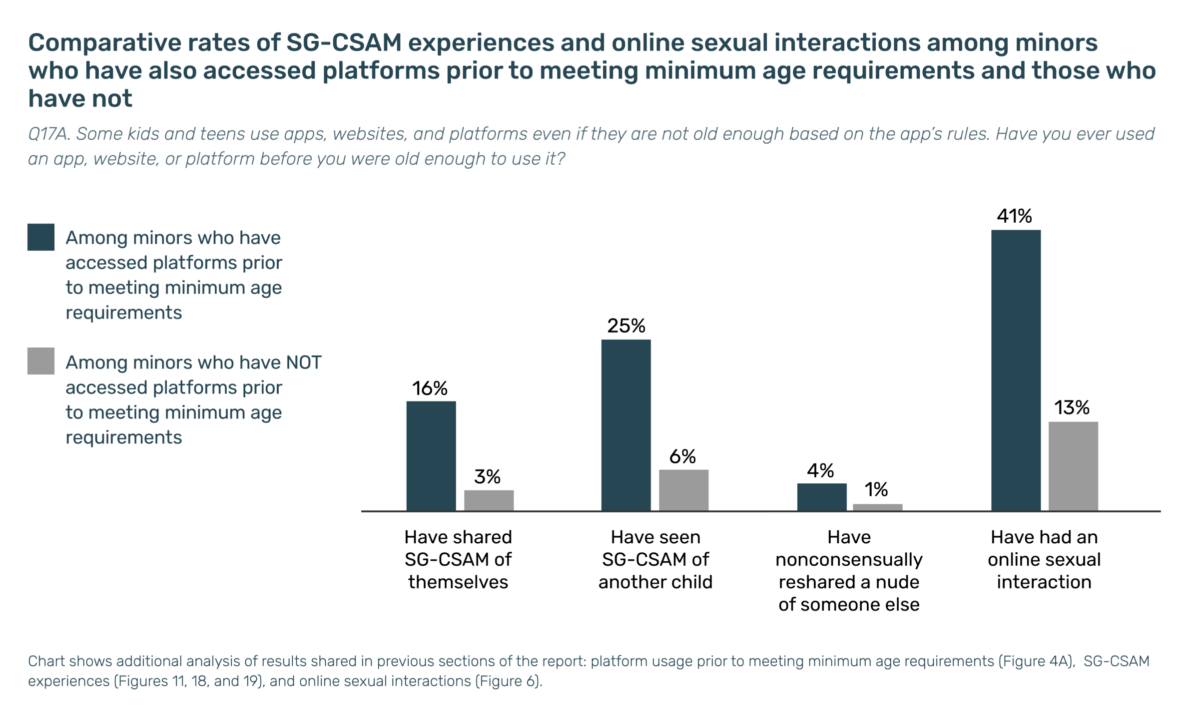 This situation highlights an ongoing problem. Age limits alone don’t seem to keep young people out of places not meant for them. Nor does it reduce their exposure to risky content. Age limits are an important safety tool, but more needs to be done to ensure they work properly and are consistently combined with other, longer-lasting child safety measures.
Fear and shame make kids less likely to share their experiences. Since 2020, surveyed minors have said they use safety features on platforms, like blocking and reporting, more than asking for in-person help. This includes reaching out to a caregiver, friend, or trusted adult. On average, 43% more minors have used online tools rather than in-person help to respond to an online sexual experience. Online safety tools remain an important way for children to respond.
2x
Minors who had an online sexual interaction were nearly twice as likely to use online safety tools than to seek offline support.
Looking at the data over the years, we can see that in 2025, fear of shame and judgment grew as a reason young people held back from disclosing. This applies to both what ultimately influenced them not to share a nude of themselves and not seeking support among those who had. Youth attitudes towards those whose nude images have been leaked reinforce this worry, with 1 in 3 young people surveyed still blaming victims whose nude images were leaked.
Over time, some worrying trends have surfaced with 9-12-year-olds seeking out help. Since 2020, preteens have been more likely to say they used an online tool and less likely to ask for help offline. In contrast, teens’ use of online tools has stayed about the same, and more teens have said they asked for help in person since 2020. Data from 2025 show a rise in preteens who said they did not tell anyone about their online sexual experience. This includes using an online safety tool or asking a person for help.
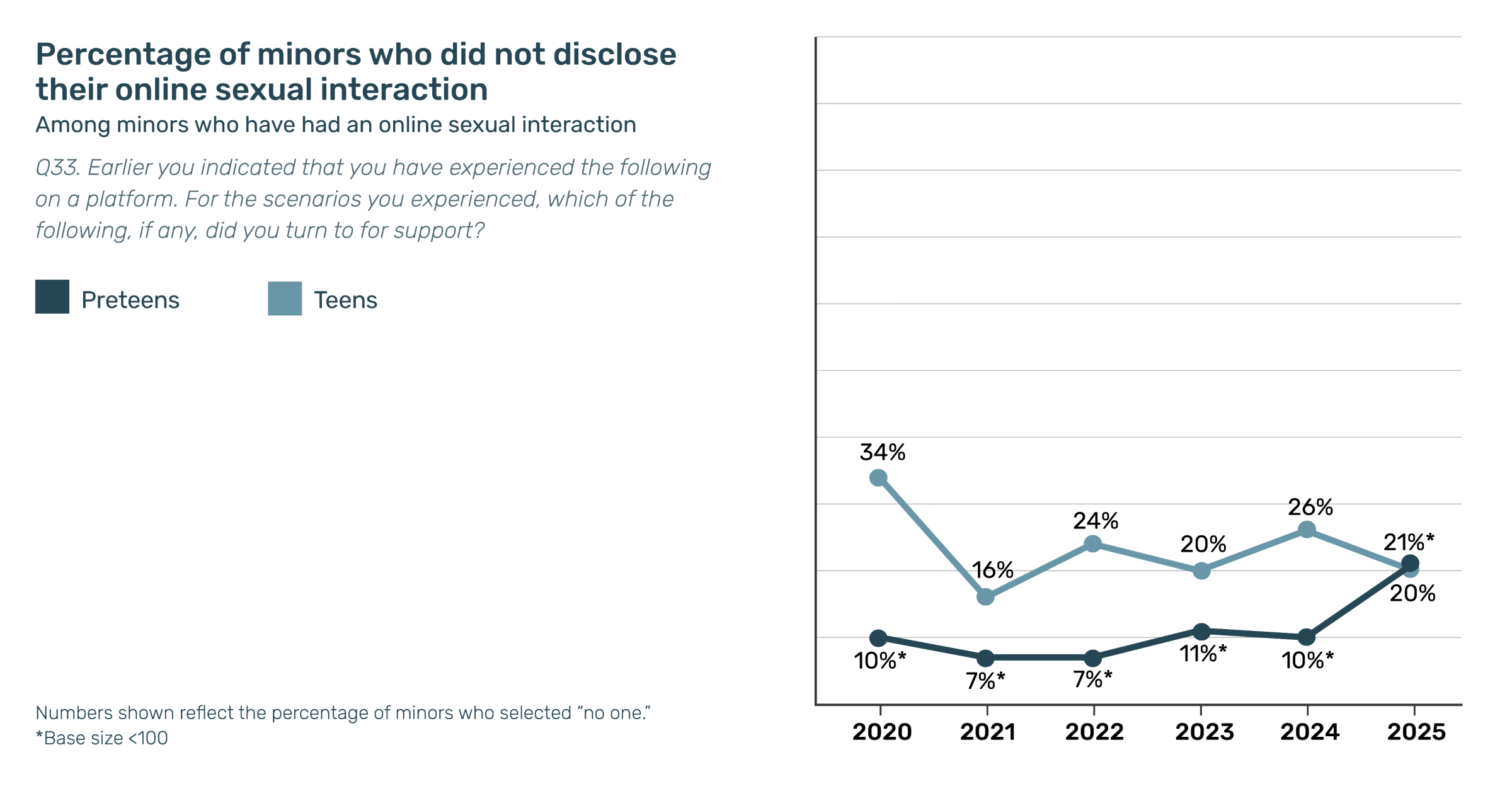
The child safety ecosystem can continue to encourage and support more face-to-face help-seeking. Feelings of shame and embarrassment can lead to minors not talking about online experiences. This leaves them to face difficult and possibly harmful online sexual situations alone, without help, and often feeling as though what happened to them is their fault. This is especially worrisome because younger minors are still developing and may need extra help to understand and deal with these experiences, including their ideas about consent, what behaviors are acceptable, and the risks they’re navigating online.
In 2025, most surveyed minors (67%) used AI chatbots or companions — AI-powered tools that are used for conversation, information, advice, or support. More than 1 in 4 (29%) said they used these tools for private or personal reasons, like getting advice about romantic feelings (21%) and finding information about puberty or sexual health (18%). Almost 1 in 3 (30%) minors said they turned to AI chatbots or companions when something confusing or upsetting happened to them or someone else. When looking at how young people respond right after online sexual interactions, 15% sought out advice from an AI tool. That’s more than twice the number of young people who did so after experiencing bullying or being made uncomfortable online (7%). This shows that some young people may turn to AI for help when dealing with online sexual harm.
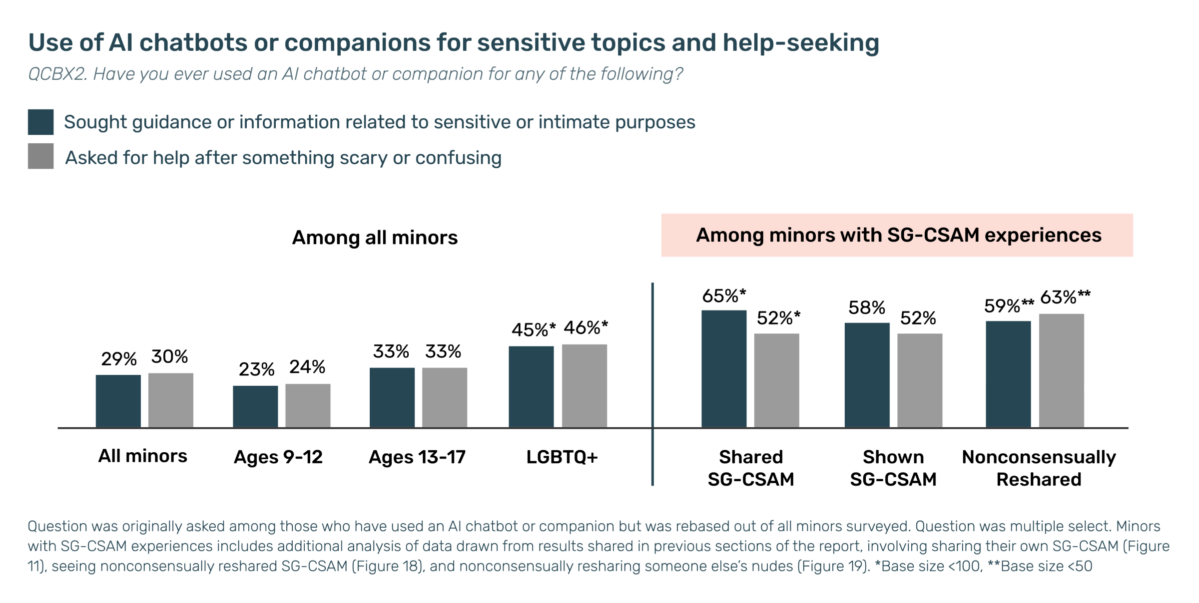
As AI technologies continue to improve, their role in keeping children safe will change too. It’s important for tech companies to understand when, why, and how young people use AI tools as they create effective safety measures. The industry can focus on the quality of the information and advice minors receive during these times. Tech companies, caregivers, doctors, and child safety partners can also use this information to help young people report issues, share concerns, and find trustworthy help and resources suitable for their age.
Young people are experiencing a mix of new and “old” kinds of online harms. Findings show that those who face one kind often report others, too. Since Thorn’s survey started in 2019, the ways online sexual experiences happen have evolved. Reports of “online sexual interactions” in our yearly surveys, which include requests for nude photos and sexual messages, show that getting sexual messages and being asked to send nude photos or videos remain common but less frequent than in past years. In 2025, more than 1 in 4 (27%) minors said they had at least one of those types of online sexual interactions.
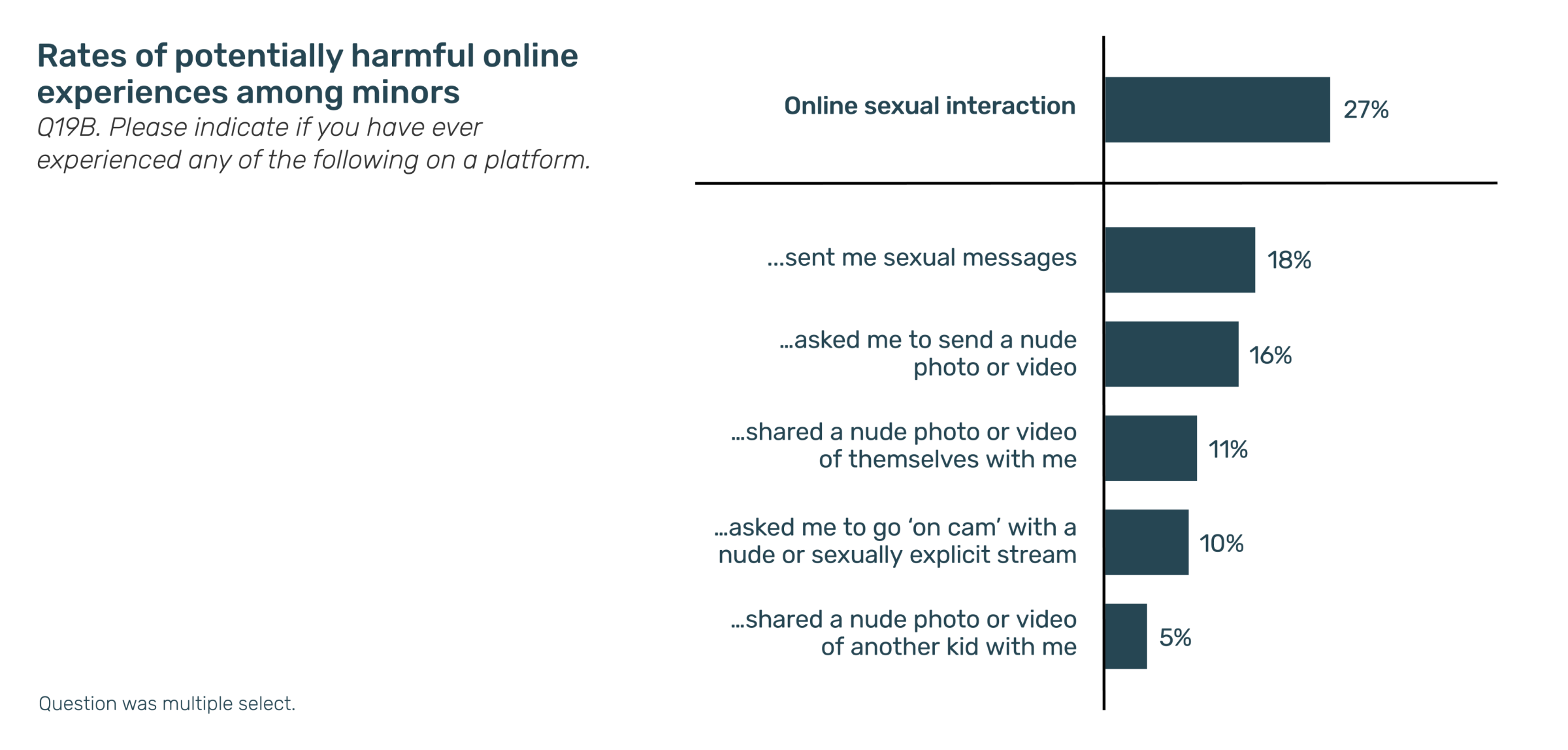
Because the online world is ever-evolving, how we measure these experiences has also adapted. This now includes deepfake nudes, AI-generated or digitally altered nude images or videos that depict a real person, often created with face-swapping or “nudify” tools. It also includes sexual extortion, when someone shares someone else’s sexual image to pressure or force them to do something.
When we look at additional experiences, along with the usual yearly questions about “online sexual interactions,” we get a wider picture of the kinds of online sexual harms teens navigate. For instance, in 2025, 1 in 3 (34%) teens said they had an online sexual interaction, as previously evaluated. When the analysis includes experiences with self-generated child sexual abuse material (SG-CSAM) — nude photos or videos created by a minor — as well as experiences such as sharing their own nudes, sharing someone else’s without their consent, deepfake nudes, and sexual extortion, that figure rises to 1 in 2 (45%).
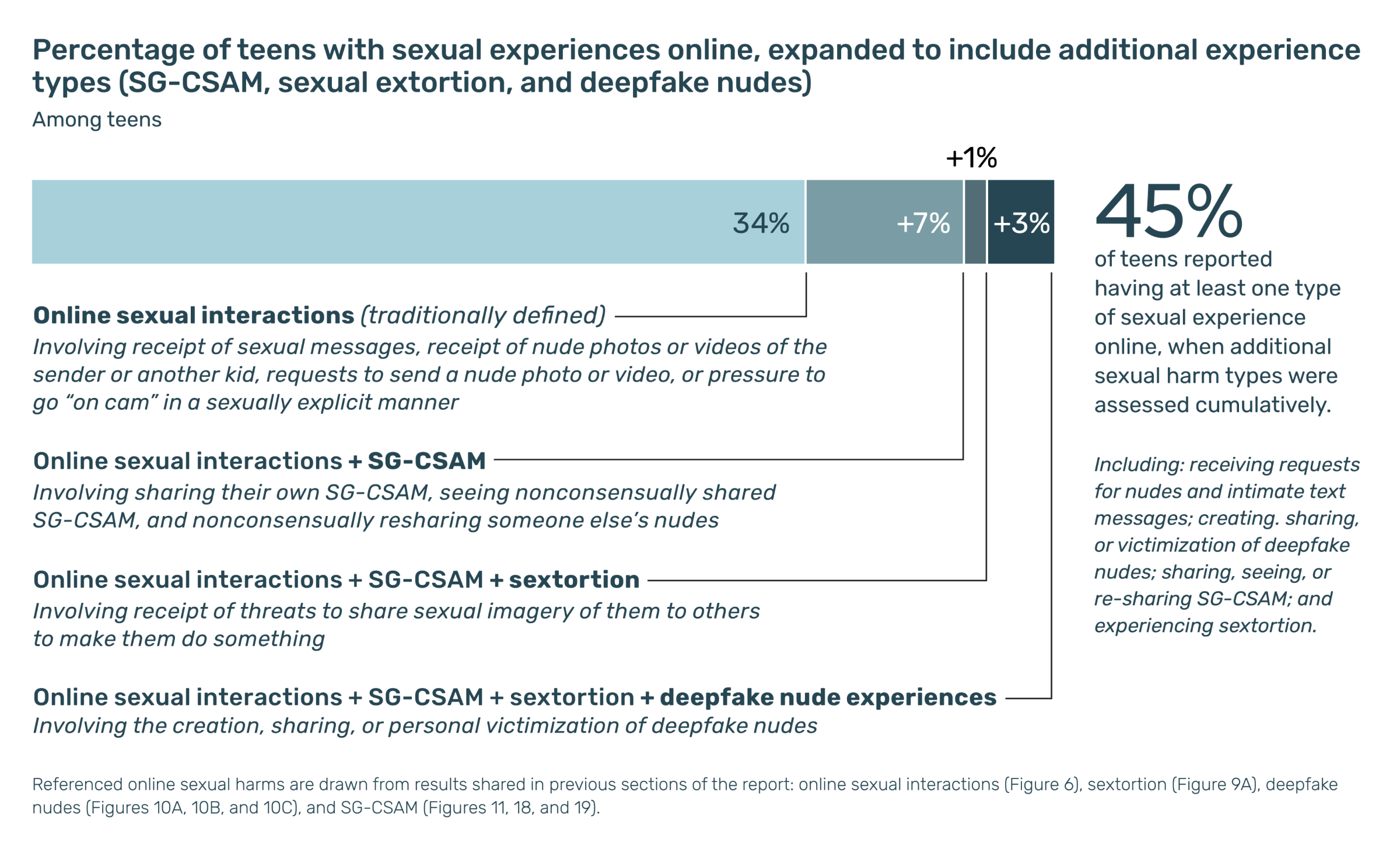
What we also found is that young people who say they’ve experienced one type of sexual experience online acknowledge they’ve experienced other forms as well. Looking closer at multiple experiences: 67% of teens who said they created or shared deepfake nudes or faced sexual extortion also reported experiencing an “online sexual interaction” often in the form of sexual solicitations. This includes getting requests for nudes and sexual messages. More than half (59%) of teens who had experiences with deepfakes or sexual extortion had also shared their own, seen or reshared nudes of others.
These extra details show how online harms are becoming more complex. As new technology and online spaces keep changing, they create new ways for harm to happen, often alongside other forms of online harm. Understanding the specific harm types is important when designing or implementing safeguards, but it’s also important to understanding and responding to the broader ways that youth experience multiple online sexual risks.
Platforms will miss critical opportunities to protect young people if they do not invest in child safety features and resources beyond age-based policies. When additional safety tools are not made for younger users, children who experience harm are even more isolated. They might avoid asking for help or reporting the harm. This is often because they fear losing access, getting in trouble, or being blamed for being in a place they “shouldn’t have been.”
It’s important that people working in digital spaces develop policies and systems that account for children entering age-restricted areas. Giving age-appropriate resources can also help young people safely use age-restricted online spaces once they meet the age requirement.
The child safety ecosystem must continue to improve its understanding of young people’s online experiences. It should encourage more young people to speak up and seek help offline. It’s important to improve both the tooling on platforms and the ways young people can reach trusted adults. Caregivers and trusted adults should help young people feel safe asking for help, even if they are doing something “risky.” This includes using a platform they were not old enough to access. Young people should know they can ask for support without fear of punishment, shame, or blame.
As AI technologies continue to grow, their impact on child safety is changing too. Young people now use AI tools to learn about sensitive topics like sexual health, relationships, and identity. Young people use AI chatbots and companions for help with emotional and possibly harmful situations, and it’s essential that their responses are high quality, supportive, and accurate. It’s important to build clear safety features into AI tools. This should be accompanied by easy ways to report problems and access age-appropriate support resources. Caregivers and trusted adults should continue talking with young people about how they use AI chatbots and companions. They should also encourage young people to talk to trusted adults in person and not just trust information they find online.
There are different ways that online sexual harms could overlap for a young person, but those who report a sexual experience online often report experiencing other types of online sexual interactions as well. Young people may experience more than one type of harm at the same time across related experiences (e.g., nude images were re-shared without consent and were then turned into deepfake nude images showing fake elements), or as separate individual experiences over a longer period of time (e.g., deepfake nudes were created and shared, and on a separate occasion, an adult asked for a nude image). Studying how youth experience these harms collectively, rather than as isolated incidents, helps us better understand what young people are experiencing and how to support them.
Websites and platforms can strengthen reporting tools and support pathways so young people know what to do, where to go for help, and what will happen after they report a concern. The design of in-platform tools, including blocking and reporting, should be oriented to help reduce stigma around disclosure by creating messages and resources that make it clear young people are not to blame when they experience harm.
Websites and platforms can also design their products and services for the reality that many young people will access age-restricted spaces before they meet the minimum age requirements. Age restrictions should be paired with age-appropriate safety resources, including clear reporting options, easy-to-find help, and support pathways that young people can use without fear of punishment or shame.
Caregivers can normalize help-seeking before anything harmful happens. Young people should know they can come to a trusted adult without fear of punishment, shame, or blame. When a child discloses harm to a trusted adult, a calm, supportive response can make it easier for them to share what happened and get the help they need.
AI chatbots and companions are becoming part of how some young people seek information, advice, and support. Caregivers and trusted adults should talk with youth about how they use AI chatbots and companions as part of broader online safety conversations.
Parents and trusted adults can help a child reporting online sexual harm by staying calm, making sure the child knows they are not in trouble or to blame, and helping them report what happened. Save messages, images, usernames, and other details when possible, but do not share or repost harmful content. If someone is threatening to share a child’s intimate images, learn what to do and how to report it here.
This data was collected through an online survey of 1,003 minors from across the United States from November 12 to December 1, 2025.
A Parent’s Guide to Digital Safety: Practical guidance to help parents and caregivers understand online risks, build healthy digital habits, and respond to issues including cyberbullying, harmful content, sexual exploitation, and generative AI.
Get Help Removing Explicit Content Online: Resources from the National Center for Missing & Exploited Children to help young people and families report and remove nude or sexually explicit images or videos shared online.
Internet Watch Foundation: Guidance for parents and caregivers on how AI can be used to create or alter sexual images of children, with practical steps for protecting children’s photos, discussing the risks, and reporting harmful content.
If you’d like to reference information from the report, our preferred citation is:
Thorn. (2026). Youth perspectives on online safety, 2025: An annual report of youth attitudes and experiences.
Available at: https://info.thorn.org/hubfs/Research/Thorn_2025YouthPerspectives_Report.pdf
Join our research distribution list to stay up to date on our latest research findings.