
When every moment matters, Context Labels help accelerate child safety
September 21, 2026
5 Minute Read
A child sexual abuse investigator might face upwards of 30,000 cases in a year. With each of those cases potentially involving thousands of electronic files, identifying abusive material is a true needle-in-a-haystack problem.
The same is true for trust and safety teams at tech platforms. Their tools might flag thousands of suspected child sexual abuse images a day. How can they ensure their reporting provides sufficient information to enable investigators to more quickly triage reports and focus on the most severe cases to help children in harm’s way?
This dilemma is why Thorn developed Context Labels: to give investigators and trust & safety professionals additional useful information as they review suspected child sexual abuse material (CSAM).
How Context Labels strengthen detection
Advanced tools, like CSAM classifiers, identify files that may contain child sexual abuse. That first signal gives investigators and trust and safety teams a critical starting point. But Context Labels go further, adding another layer of information so professionals can evaluate the severity and relevance of what the files may show.
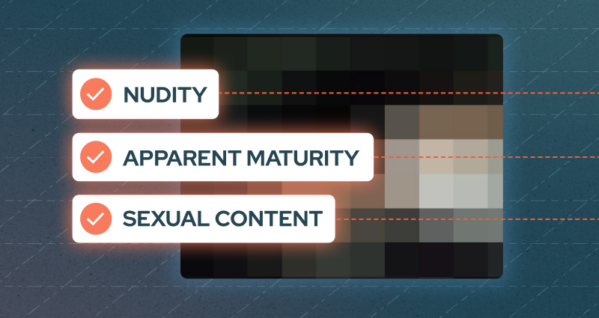
Thorn’s Context Labels use specialized machine learning models trained on confirmed abuse material. These models analyze images and label them based on apparent maturity level, nudity, and sexual content. This lets platform moderators and investigators focus their attention based on those additional indicators.
Context Labels help high-priority cases move faster
Digital files don’t often arrive in a neat order. Investigators may receive hard drives, phones, or cloud accounts seized during an operation. A single case can create days or weeks of review. First, the CSAM classifier predicts which files may contain child sexual abuse material, which helps narrow down the large number of files for the investigator. Next, the Context Labels help organize the material. Investigators can use that information to assess which files may need the fastest response.
With the Context Labels and CSAM Classifier in place, an investigator may discover a critical image earlier. A social media moderation team may identify patterns emerging across their platform. A report may reach the right agency with more precise details about what the image contains. Each improvement creates room for experts to focus on the child behind the material.
Thorn Detect brings this ability into investigative workflows. Thorn Detect helps investigators identify suspected CSAM within digital materials. Context Labels give investigators more information as they decide what steps to initiate for a case.
Safer, Thorn’s purpose-built platform safety tool, brings the same capability to technology companies. Moderation teams use Safer to detect, review, and report suspected CSAM on their platforms. Context Labels help those teams understand the material they encounter and prepare more nuanced information for their reports.
The two products serve professionals at different points in the response. Together, they show how one technical advance can strengthen the wider child protection system.
Context Labels support collaboration across organizations
Child sexual abuse can cross regions without interruption in today’s digital age. A platform may serve one country while a child being abused lives in another. If files pass through several layers – platform detection, a reporting clearinghouse like NCMEC, a referral to law enforcement – before reaching the investigators who can help, shared language can make these handoffs smoother.
Thorn’s Context Labels follow the Universal Classification Schema developed by INHOPE*. These are uniform categories agreed by INHOPE and its partners, with the goal of using a shared language across the child safety ecosystem. This creates greater consistency when platforms, nonprofits, and investigative agencies describe suspected abuse material. A report with consistent categories gives the next team universally understood information. Investigators can understand what a platform found. Agencies in different regions can interpret the material through the same framework. Partners can compare patterns and decide where resources may have the greatest impact.
How does Thorn innovate for child safety?
Thorn develops technology in close partnership with the professionals who use it. In fact, the apparent maturity level, nudity, and sexual content classifiers were developed with the support of the INTERPOL DevOps community.
The technology began with a need for more information to prioritize large volumes of suspected CSAM. Thorn built the models and tested them with experts, gathering feedback on their usefulness, clarity, and practical application. Those insights helped shape the technology before we integrated it into Safer and Thorn Detect.
We then worked iteratively with experts to determine if the Context Labels were understandable across regions, whether they surfaced useful distinctions within large CSAM datasets, and how they could support prioritization or triage.
Child protection depends on this kind of continuous innovative development.
Perpetrators change their methods. New technologies create new risks. The volume of digital material continues to grow. The solutions need to scale alongside the threat.
Donor support enables Thorn to build innovative tools, conduct research, and form partnerships that help child safety. It supports the technical innovation behind products like Safer and Thorn Detect. Every critical file may carry information about a child. And giving investigators more information can help them find that child faster and move them closer to safety.
*Thorn’s use of the Universal Classification Schema is provisioned through a license with INHOPE. INHOPE exclusively holds all intellectual property rights in and to the Schema, and any use of the Schema outside of Safer or Thorn Detect is subject to INHOPE’s consent.
Get the latest delivered to your inbox
Related Articles
5 min read
2 min read